Every chess move is a new sound.
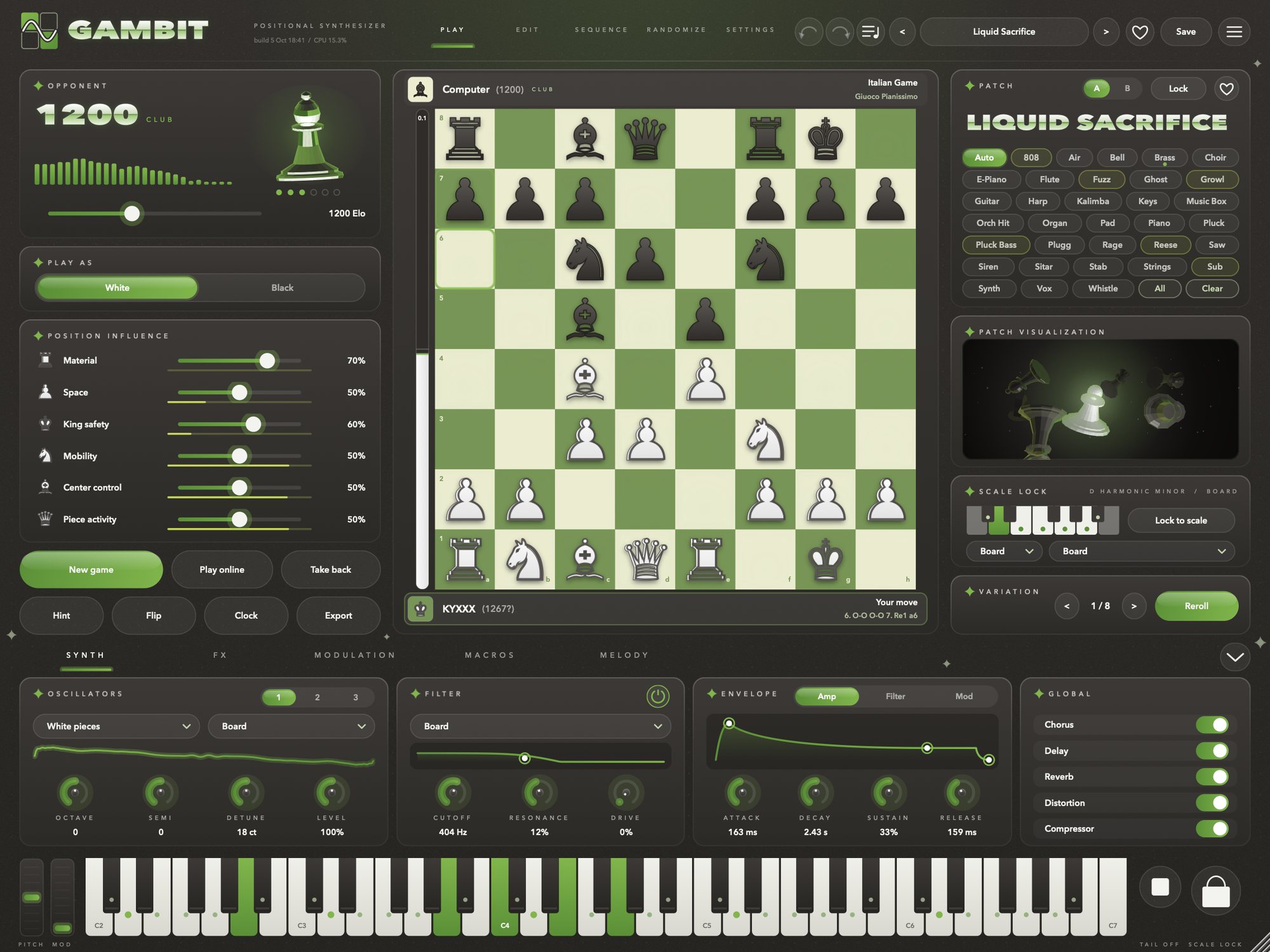
Gambit is a synth you play by playing chess. Make a move and the position on the board becomes the patch. Chess has more possible games than there are atoms in the universe, so you will never run out of sounds.
Plays inside FL Studio, Ableton Live, Logic Pro and any DAW that loads VST3 or AU.
You've already heard every preset you own.
So has everyone else who bought the same pack. When every producer scrolls the same library, every beat starts to sound like the last one.
- ?!You scroll presets for an hour and close the project with nothing.
- ?The melody you finally pick is one a thousand other beats already use.
- ??Beat block hits, and nothing in your folder sounds like a starting point anymore.
possible chess games. Each position builds its own patch.
That number is the Shannon number, the classic estimate of how many different chess games exist. Gambit reads the board after every move (material, space, king safety, mobility, centre control, piece activity) and turns it into oscillators, filters, rhythm and effects. A new position means a new sound.
Bar heights use a log scale. Counts are the number of possible games after each half-move, from the starting position.
Make a move. Hear the position.
No sound design homework. The board does the sound design, and you keep the sounds you like.
Load Gambit on a track
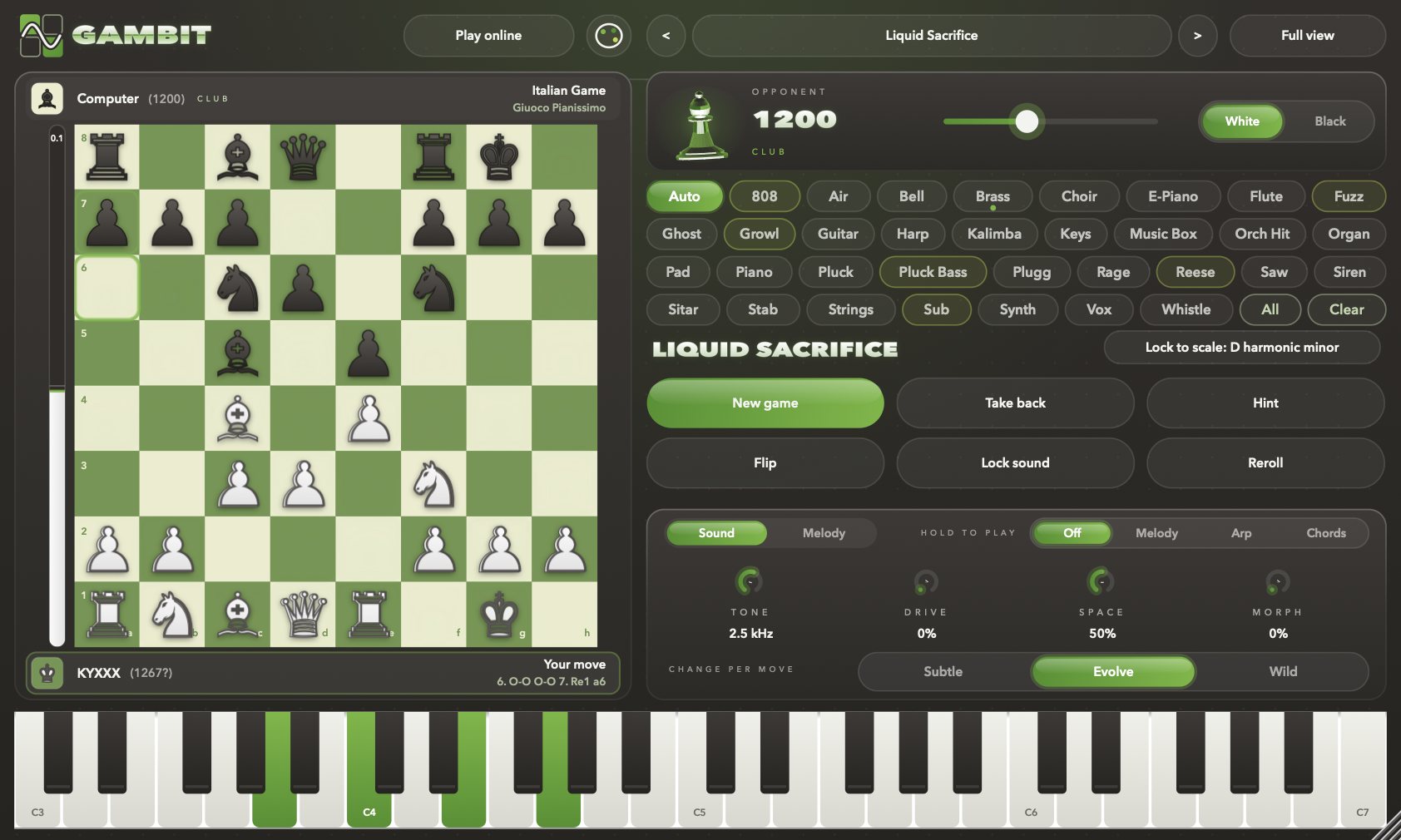
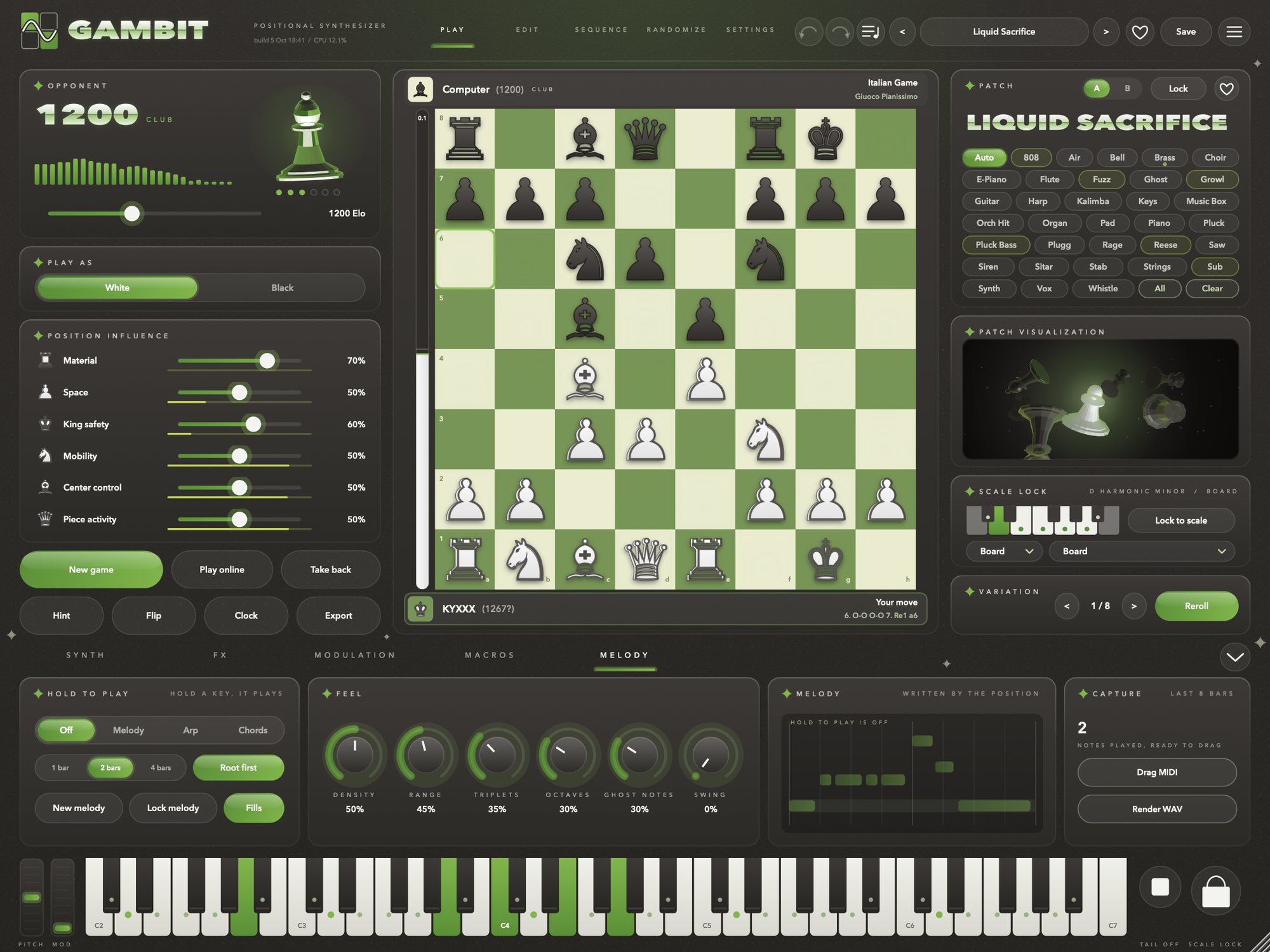
It opens in a compact view sized for a laptop screen, with the board, your opponent and every instrument in one place.
Play a move
Drag a piece. The computer answers at the strength you chose, from 400 to 2400 Elo.
The board becomes the sound
Six features of the position drive the patch. Every move gets a name, a key and its own sound.
A real opponent, between takes.
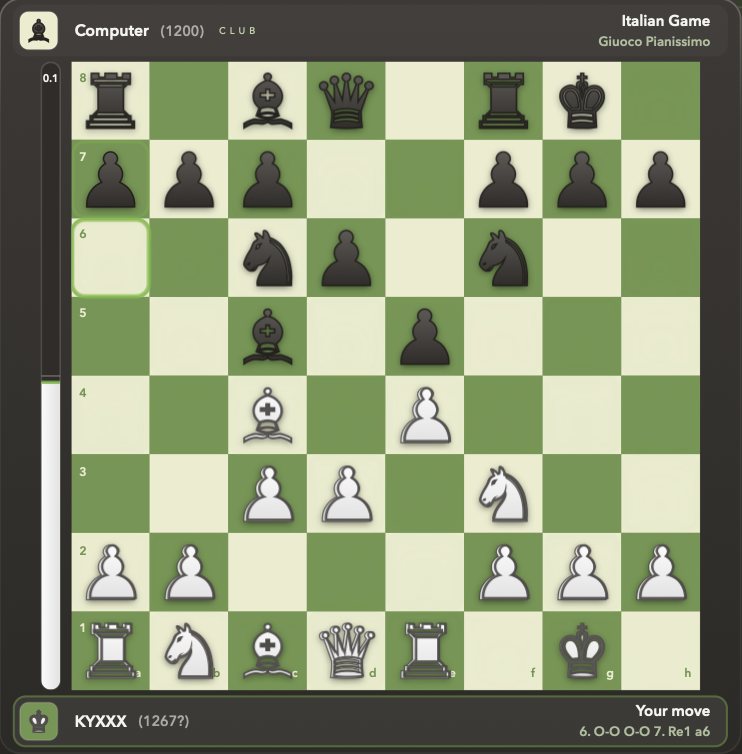
Gambit has a chess engine built in, so there's no second window and no browser tab. Your game lives inside the project and saves with it.
- Plays like a person at its level. Weaker settings make human-style inaccuracies instead of random blunders. At 1200 it rarely hangs a piece.
- Live evaluation bar. See who's winning after every move, like a game review.
- Chess clock in bars. Time controls of 8 to 64 bars, locked to your project tempo.
- Your game saves with the project. Close the session, open it next week, and pick up the same position.
Get better at chess without trying.
Gambit is a patient sparring partner. It shows you what went right and what went wrong, then lets you try again.
- Move commentary. Every move is rated the way online review tools do it. Brilliant is saved for real sacrifices.
- Hints and take-backs. Stuck? Ask for a hint. Blundered? Take it back and find the better move.
- Opening names. Nearly 300 opening lines with variations, named on the board as you play them.
- Choose your opponent. Start at 400 and move up as you improve, all the way to 2400.
Every sound is mix-ready.
Infinite sounds are useless if half of them are noise. Gambit's engine is tuned for hard, usable trap sounds, and it guards your ears while it does it.
Pick one, or let the board choose
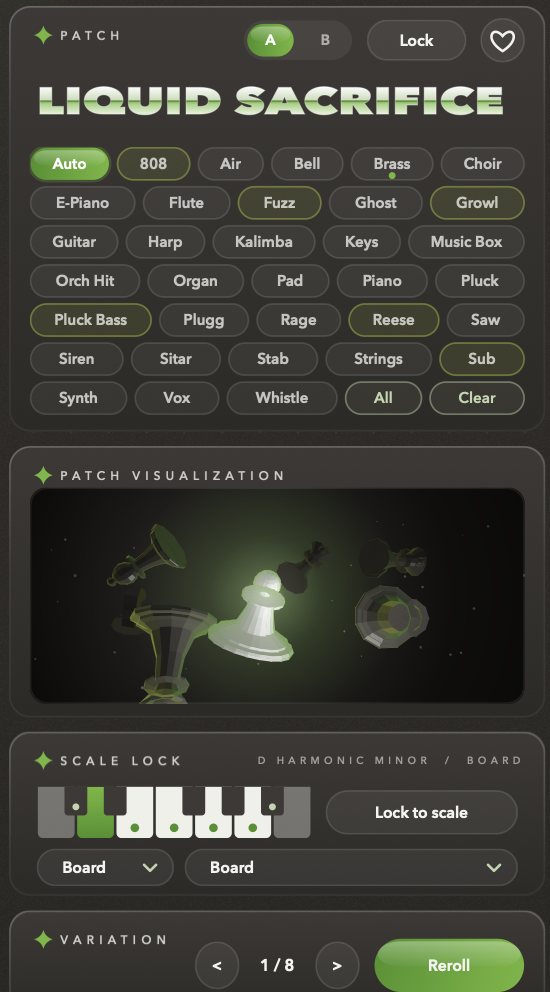
Bells, plucks, keys, pads, choirs, brass, sirens and six basses including 808, Sub and Reese. Select several and every move picks between them.
Subtle, Evolve or Wild
Decide how far each move pushes the sound, from gentle variations to a whole new patch.
Drag MIDI straight to the playlist
Turn the current position into a phrase, then drag out the MIDI or render it to WAV.
Hard −6 dBFS ceiling
A blast guard stops runaway levels before they reach you. Gambit never turns itself up.
Lock, A/B, morph, favourites
Lock a sound you love, compare two, morph between them, and save it as a preset in one click.
MIDI learn, undo, full recall
Map any control to your controller. Undo and redo everything. FL saves the whole game and sound with your project.
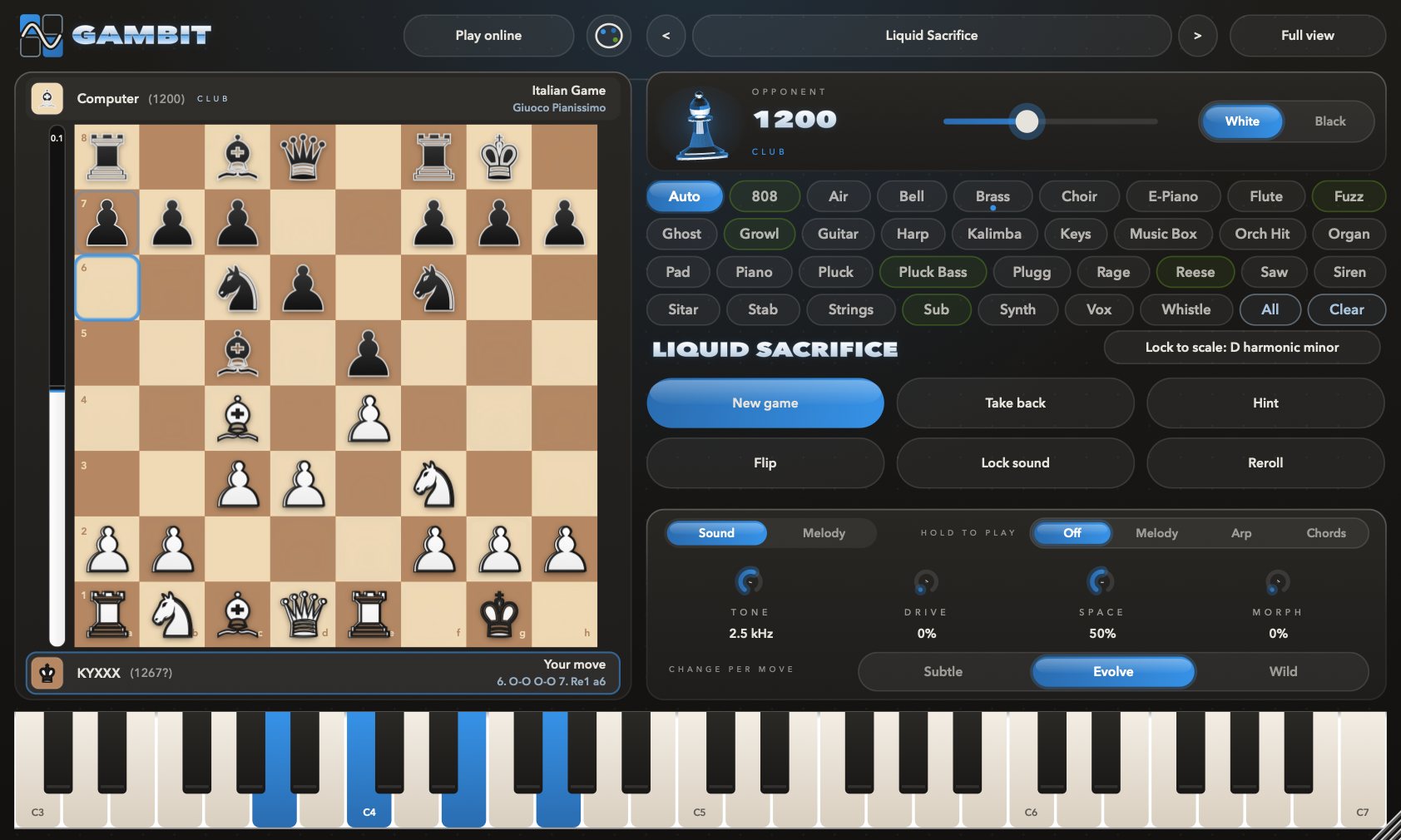
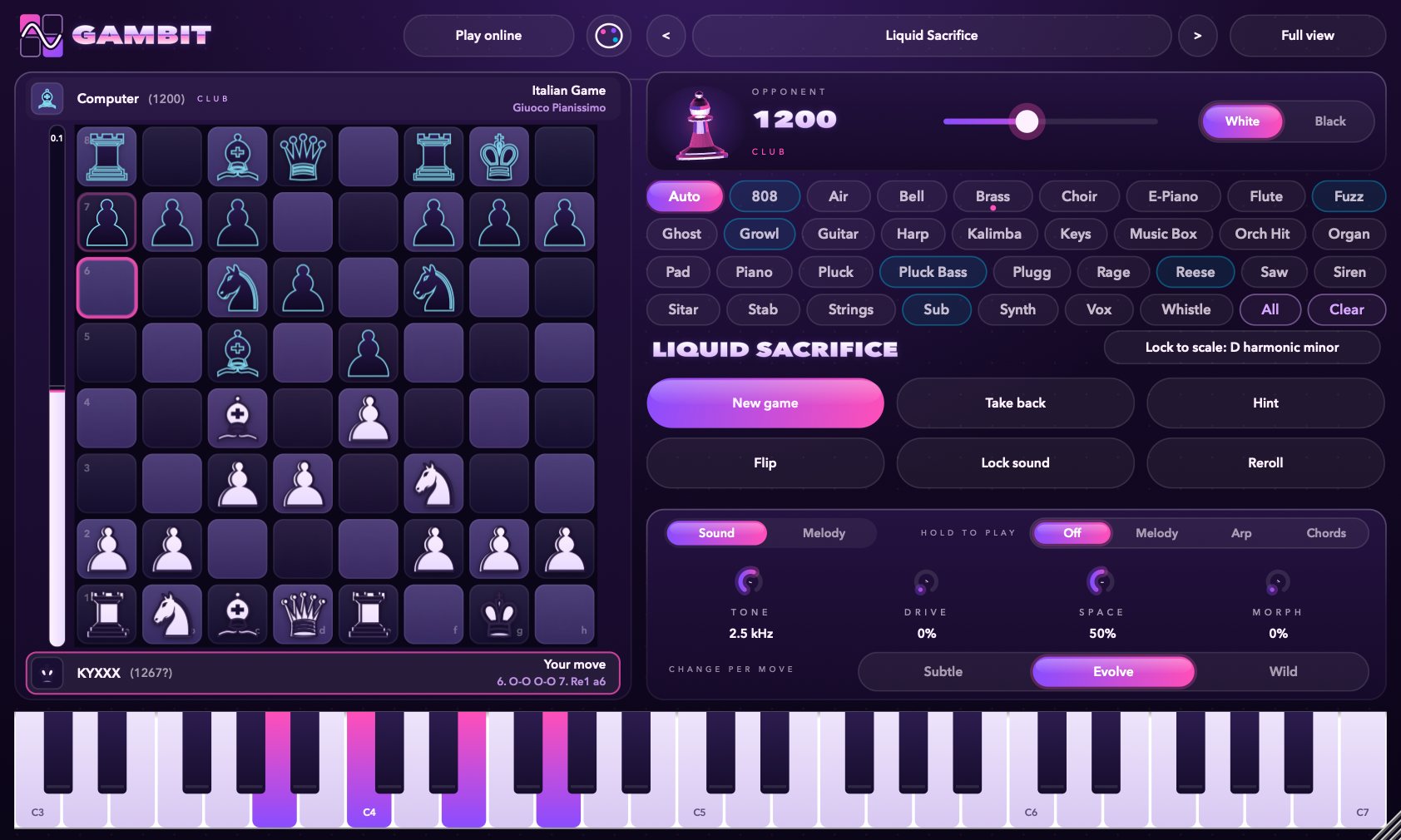
Ten board themes, from tournament green to vaporwave.
Play on the flat green-and-cream or wooden boards you already know from online chess, or pick something louder. Themes recolour everything, including the visualiser.
Stop scrolling presets. Start a game.
Everything in Gambit
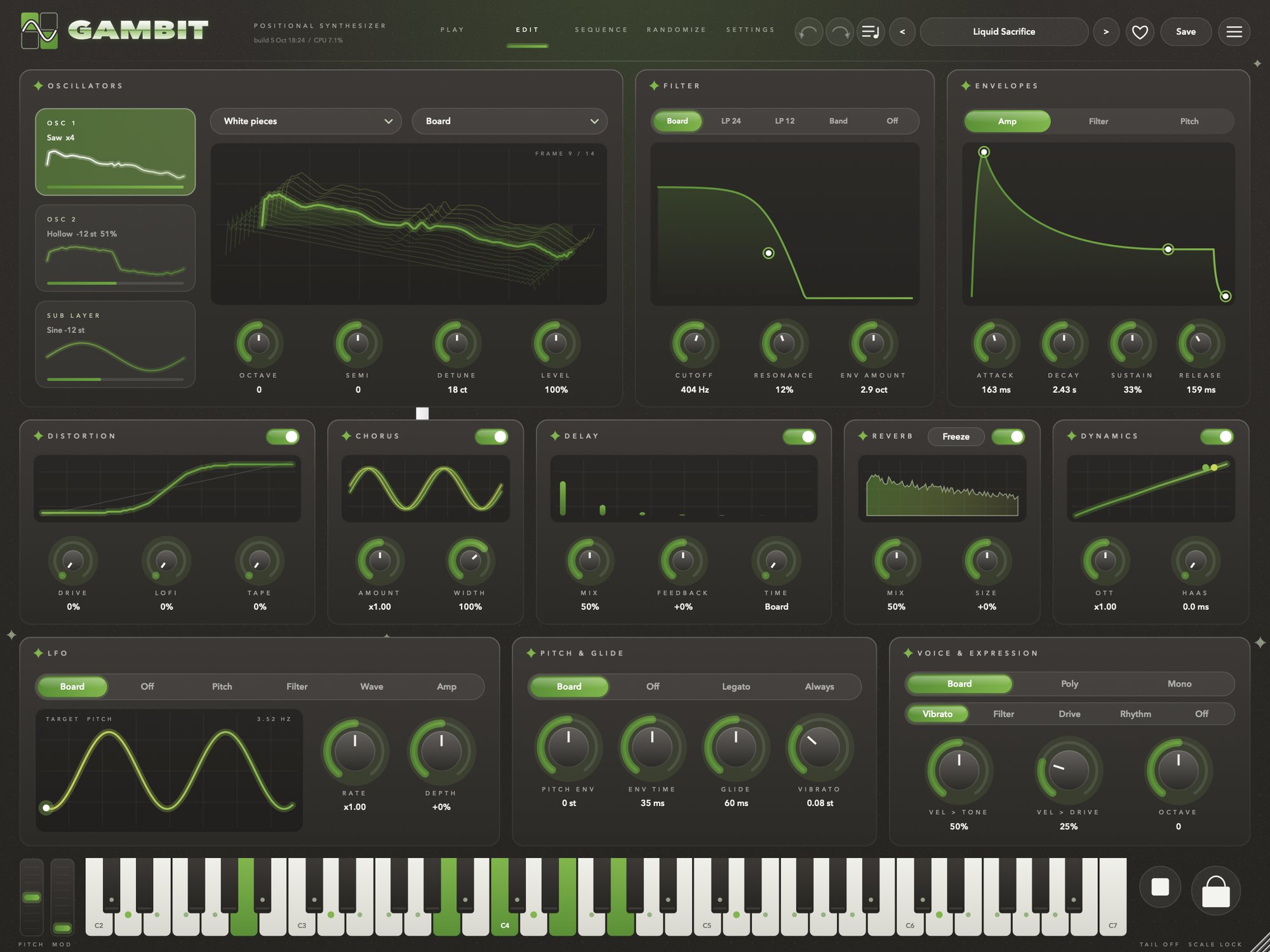
- The synth. 32 instruments, a board-driven patch on every move, and full edit, sequence and FX pages.
- The chess. An opponent from 400 to 2400 Elo with hints, take-backs, an eval bar, a chess clock and move ratings.
- The workflow. 38 trap presets, MIDI drag-out, WAV render, MIDI learn, A/B, morph, undo and full project recall.
- The look. Ten themes, compact and full views, and window sizes to fit any screen.
- Instant download
- Every format in one installer
- Yours to keep, no subscription
Before you play
Do I need to be good at chess?
No. Set the opponent to 400 and use hints and take-backs as much as you like. You can even let the computer play both sides and just listen. You'll pick chess up along the way.
Which DAWs does it work in?
Any DAW that loads VST3 or AU plug-ins on macOS, including FL Studio, Ableton Live, Logic Pro, Studio One and Reaper. There's also a standalone app if you just want to play.
Will the sounds actually fit my beats?
Gambit is tuned for trap. Every generated patch goes through usability checks for harshness, mud and level, and the sound follows a key you can lock to your track.
What if I find a sound I love?
Lock it, so it stays while the game carries on. Or save it as a preset, favourite it, compare it with A/B, or drag the loop out as MIDI.
Is it safe for my ears and speakers?
Yes. Output is hard-capped at −6 dBFS, and a blast guard catches any runaway level before it reaches you. Gambit never applies automatic gain.
Is there a Windows version?
Gambit launches on macOS, running natively on Apple Silicon and Intel Macs.
1. e4 ...
Your next melody is one move away.
Open your DAW tonight, play a game, and bounce the position you like best.
Get Gambit